

Casi
madrileña
Ten days, one backpack and no real plan along the Basque coast.

Everybody said it before I left. I had been circling País Vasco for years, and this August I finally went to see for myself. Ten days, alone, my first time in País Vasco.
I have a confession. It never felt like another country to me. The people I met were as warm as anyone I know in Spain. Older people helped me with endless patience. Some heard my accent and switched to English, very politely, to rescue me. Each time I switched back. No, no, I'm not a tourist, I live here. Soy casi madrileña. Each time I got the same small smile, and we carried on in Spanish. Maybe the only real difference is that the north speaks better English, with all those visitors, and in August there are plenty. I kept those small exchanges anyway, the way other people keep fridge magnets.
I moved along the coast by bus and on the Euskotren, the little train that runs through the forest. Green on one side, green on the other, a flash of ocean, then green again. This is the kind of travel I love most. You get on, you get off, you follow a path, and suddenly you are close enough to the waves to feel how strong they are.
In Zarautz I ran into the sea, so happy. The first big wave swallowed me whole and threw me back onto the sand, as if the ocean had checked my papers and decided I wasn't local enough yet.
So I did the only reasonable thing. I lay down on the beach and slept for two hours.
Zarautz has that easy northern mix: a green hill to climb, a long beach, surfers in the water, hipster culture and local life side by side. Plenty of tourists, yes, but the mood stays low-key.
When I woke up, I started walking. Around five kilometres of the Camino along the coast, with no plan beyond the next bend. I dropped a pin on the map, followed it, and found myself in front of the Balenciaga Museum in Getaria. I hadn't planned it at all. By the evening I was exhausted and very happy. Let's go and see what happens. That was the whole philosophy of the trip, and it worked.

Laida, low tide
To reach Laida from Mundaka, you cross the estuary in a small boat. I joked with the man who looks after the boats and with the woman at the wheel.
I was the only passenger in a life jacket, because I'm not a good swimmer, and she gave me the smile reserved for people like me. One of those. Fine by me.
On that side of the water, people talk about the tide the way Madrid talks about traffic: when it's low, when it's high, where you can walk and where you can't. Laida is a kilometre of golden sand until the sea comes back without asking your permission and the beach disappears under it. You grab your towel, your bag and what is left of your dignity, and you move.
Nature is nature. You respect it, and you adjust.
Right on the beach is Atxarre, a small bar where I ate some of the best pintxos of my life and drank one of the best coffees, a simple café con leche. The view was majestic. People came and went all day, and the guys behind the bar sang while they worked. Fast, loud, funny, and nobody complaining.
You can tell when people are truly happy to live where they live. That kind of thing can't be faked.
Mundaka
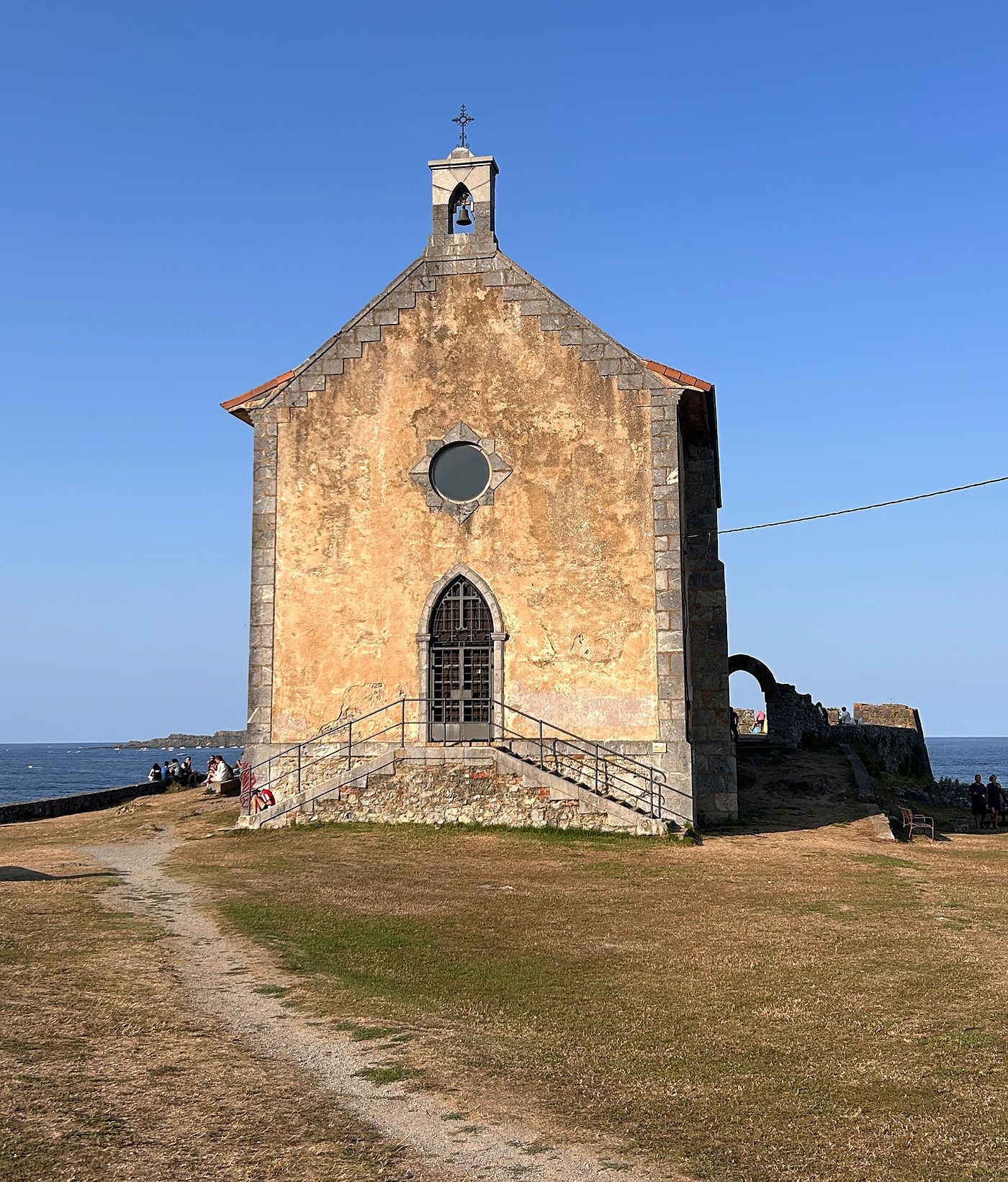
Mundaka keeps a special place in my heart. Early one morning I walked past the chapel of Santa Catalina on the headland. The sun was coming up, people were doing yoga in front of the chapel, and behind them there was nothing but ocean. No city can give you that. It is the feeling of living next to nature, and somehow it is also cosy. I still can't explain it. I only know I want to go back.
The only other place that has ever made me feel this way is Tarifa. But Tarifa is bigger and more hipster, and Mundaka is a tiny village. There weren't even that many surfers. In summer the famous left-hand wave mostly sleeps. The surfers come later in the year, when it wakes up.
It was the first time I had travelled alone for so many days, moving from place to place with a backpack. I don't really do backpacking anymore. I even slept in hostels, for the first time in ten, maybe fifteen years. The bunk beds hadn't changed. I had. Every day I planned something for myself, and some days the plan was simply to get lost and see where I ended up. In its own quiet way, it was spiritual.
This issue is what I found along the way. And I will be back.
Wiktoria Skiba