


I’m quite famous for my tiny obsessions — so of course, it couldn’t be any different when I decided to paint my new flat. I painted all the walls white on purpose, just to keep things calm and clean. But deep down, I knew one wall had to be something else — something bold, something that would define the entire living room and mark it as an art space.
I spent almost two months searching for “the one.” Wallpaper after wallpaper — online, offline, and everything in between. I liked some of them, but I wasn’t in love with any. It became a daily habit, scrolling through Pinterest like a maniac, hunting for that one image that would make my wall feel alive.
And then it happened. I stumbled upon this interior — light mint walls and a painting of a woman, probably Brazilian or African, seen from the back, overlooking the sea, with a gigantic sun above her. The colors were insane. Her flowing dress, the contrast, the warmth — everything about it was pure magic. I’d never seen anything like it.
Of course, the first person who came to mind was my friend Carlos (art name Tetoux), a well-known muralist in Madrid (you might’ve already read about him in my magazine). He once told me he just wanted a white wall to paint on — which stuck with me. So naturally, I messaged him, casually saying:
“Hey, do you want to spend a few weeks locked in my apartment painting a gigantic 195 cm mural? Or do you have something smarter to do?” To my surprise, he said yes. And that’s how the madness began.
We spent almost a month working on the project — a few times a week, a few hours at a time. I thought the hardest part would be drawing the woman or capturing the movement of her dress. How wrong I was. The real nightmare was finding the right color.
And here’s the thing about buying paint in Madrid: you go to a “specialized” store, they show you a printed palette on paper, and somehow you’re expected to imagine how that will look on your wall. When we asked if we could test the paint on a sample wall or even cardboard, the staff looked at us like we had just landed from Mars. Apparently, such things don’t exist here.
So there we were — me and Carlos, surrounded by buckets of paint, mixing shades on the floor like two slightly deranged chemists. Between my client calls and working with legal on AI usage clauses, I was still mixing and testing colors. Add to that constant cleaning of paint stains everywhere, and you get the full picture.
After all had been done, we sat together and had a conversation about our experience over the month.
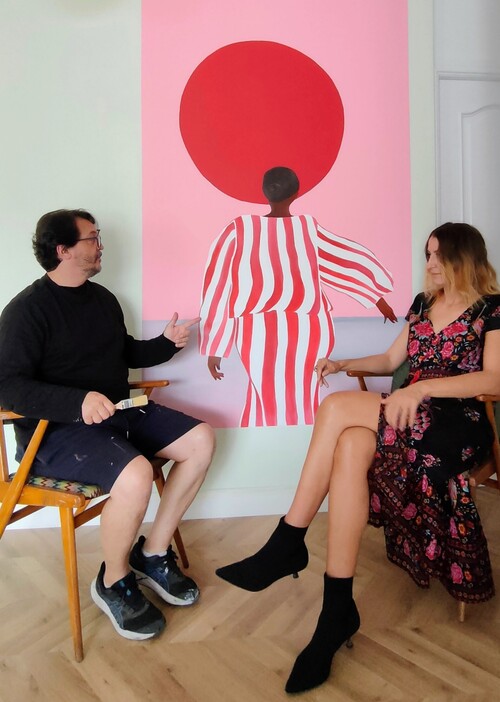
How It All Started
Me: So Carlos, how it all started… basically, I remember that one day you told me, “All you need is a white wall.” It was when we met in the flat of your friend, in Lavapies, where there was this joint project to paint. And then I finally got my flat and the white wall.
Originally, as I mentioned, I wanted to do wallpaper, but I couldn’t find one I really loved. And then you came to my mind. I casually called you and asked, “Hey, would you like to paint my wall?” But originally, I was thinking to just use one bold color and maybe some little shape or something that could remind us of a wallpaper.
Until the day I saw on Pinterest this lady — a beautiful woman, Caribbean, Brazilian, we don’t know exactly — and I showed you the photo. I asked, “Would you be able to draw that?” What was your first thought?
Carlos: All I thought — to be honest — was that it was a beautiful picture. I guess I got interested in painting it immediately. I was also analyzing the level of detail. I started thinking about the process right away.
Me: But were you afraid? Because, you know, normally you deal with sprays, right? And you told me one day that you were interested in going into home decor. Obviously, at homes, you can’t really use spray on the walls — you’d have to use paint. Were you afraid that this was something a little different from what you usually do?
Carlos: No, I wasn’t afraid. I’m actually more used to painting than spray painting, to be honest. My background comes from drawing, and I know that I can paint. I know my limitations, but those limitations are the same with spray cans. It’s all related to skill level.
So no, I wasn’t afraid. Normally I don’t feel fear — I feel more… what’s the word for this?
Me: Like when you accept a challenge, it’s like a drive, right?
Carlos: Yeah, exactly. So you could say I was more excited than afraid. There’s always something that draws me in, that makes me say, “Okay, I’m going to do that.”
First Home Decor Project
Me: And this was one of your first home decor murals, right? In someone’s private apartment?
Carlos: Oh yeah. I used to work mostly in public spaces — streets, commercial places like restaurants and bars — some interior and exterior decor, but mostly commercial decoration. So this one… I can consider this my second real home decor project. The first one happened just about a week before this one — both opportunities appeared around the same time when I started getting interested in doing work like this.
Me: We spent a few weeks on that. We met every week, a few times per week, and spent several hours at my house. At any moment during this process, did you feel frustrated or like you weren’t going to complete it? Like it was getting out of control? Did you ever have a moment of self-doubt, or did you just see the photo and think, “I’m going to do it, no matter how much time it takes”? What was your feeling?
Because — let’s give the context here — when I saw the photo, I thought the biggest challenge would be the dress. It’s a flowing dress, so it has to look like real fabric on her. But it turned out the biggest problem was finding the right colors. When we went to the stores — and later when I went by myself — the colors on the palette looked completely different once they were on the wall.
For me, what I thought would be the easiest part ended up being the hardest. You did the drawing super fast, and I was like, wow. The most frustrating part was realizing I didn’t have the right colors. That was supposed to be the easy step! What did you think about that process?
 Carlos: Yeah, my experience matched what I said before — the drawing wasn’t the problem. I knew I could replicate it because it wasn’t a very complicated drawing overall. What I was more concerned about, from the moment I accepted the challenge, was how to reproduce the scene. Because we were working from a digital image reference, and I knew the colors wouldn’t be the same. The process to reach those exact tones is much more complicated. I’m also still learning in that field, so yes — the color was definitely the most difficult part.
Me: Yeah, we learned a lot. I guess the next one will be much easier — you’ll be able to advise much more strongly, you know? And I just feel you — because at the end of the day, we were laughing that I became your creative director. I was just sitting by the table, watching the process from a distance and constantly saying, “That’s not the color. We need to mix this and that.”
We made a lot of mistakes, but every time we made one, it was because we didn’t know yet. We learned on the spot. That meant we never left anything we didn’t like — we came back, started again, and fixed it.
For me, that was the biggest learning curve, even personally, because normally I’m impatient. I realized there’s always a solution for everything — it just takes time. Sometimes you need to try several times; it’s not about giving up. Eventually, you get the effect you want.
So for me, maybe at the beginning it was frustrating, but once we had a few screw-ups and then corrected them, I knew that the next time something went wrong, there’d be a solution. We’d already proven it. I just didn’t know it would take so much time to find the right colors.
And finally, what’s your opinion about the paint stores in Madrid? Because for me, honestly, I’d give them a full business lecture on how to actually run a paint store. It was kind of a joke that they couldn’t help customers choose the right color. They’d just show a sample on a piece of paper that had nothing to do with reality. You’re an artist — you deal with paints more than I do. What’s your feeling about Madrid paint stores? Their general approach to customers, their willingness to help? Because people don’t go there for fun.
Carlos: About the first part of your question — we could call it indifference. There are many names for it, but basically it’s the relationship between clients and whoever is supposed to make their ideas concrete. You mentioned the learning curve, and yes — it’s also about the mindset we had at the beginning. We needed to think about time, budget, and other factors that are super important in professional commissions. In this case, we stayed professional, but we had more flexibility — plenty of time, a manageable budget — so things were easier. That’s why the process was so pleasant. And also because we found that common point — you, as a client, had exactly in your mind what you wanted. I really liked that. You knew what you wanted, and even when you asked me to change some colors — twice, maybe more — it was fine. I didn’t feel it was trouble. You knew what you wanted… or at least, you knew what you didn’t want. And that made it very easy for me.
Me: Exactly.
Carlos: So, the second part — about Madrid’s tiendas for painting stores. Somehow, it’s related to our learning curve with choosing the paints. Now, I learned a lot through this job, and I’m sure that in the next challenge, I’ll be much more capable — as you will be — to offer stronger solutions. We’ll need to plan and find the colors beforehand. At the beginning, we were a little bit too chill. We went to the store thinking, “Okay, we know the colors we want.”
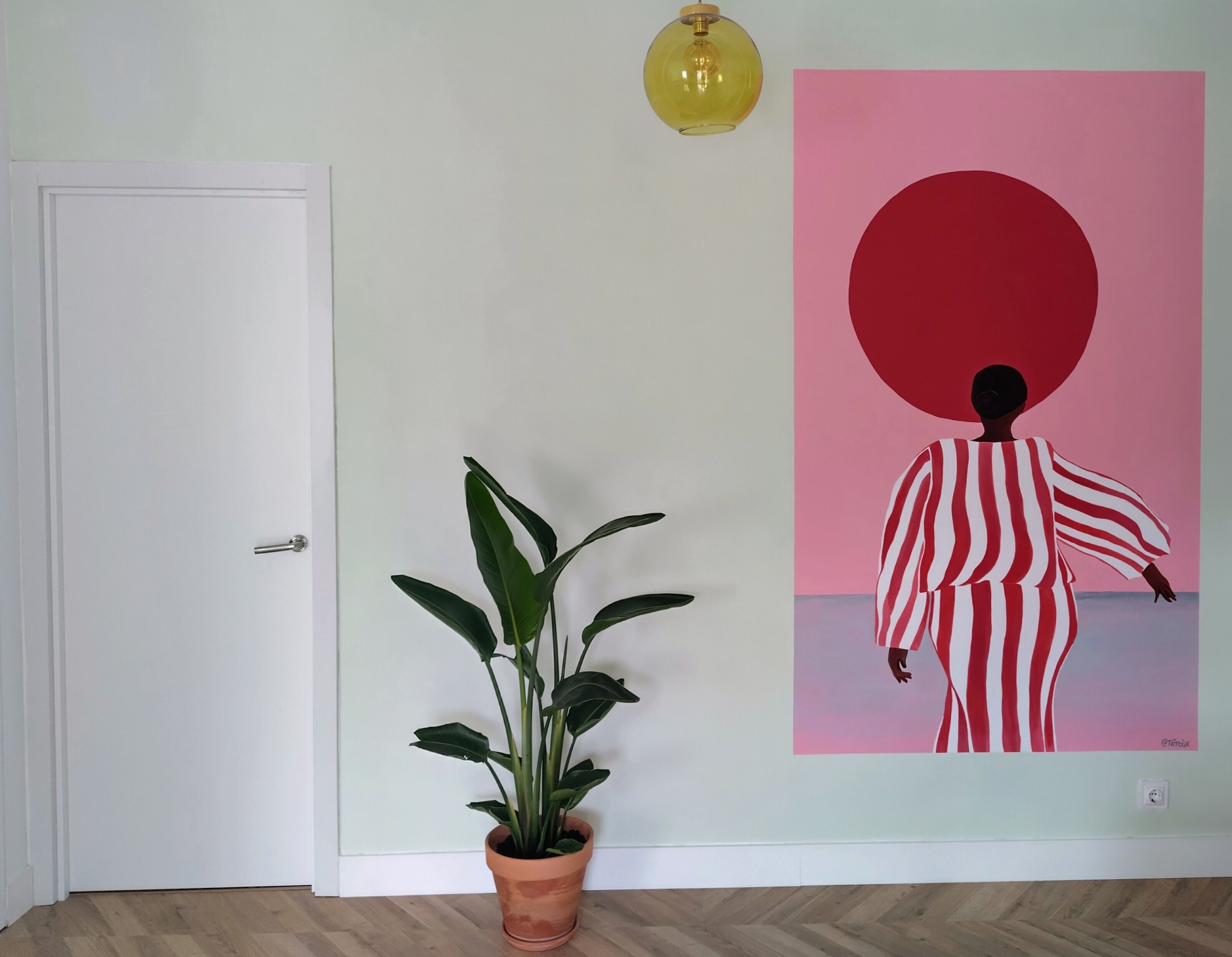
Me: They showed us the palette, and they were like Nemo fish in the store — totally lost — they couldn’t advise anything. And I was like, okay…
You know what was also funny in those stores? It was so dark. Normally, I wear glasses when I read, and I had to stand in a dark store and choose colors from a palette, not even sure if I was looking at the right one. I had the photo on my screen — on two different phones — and even then, the same photo had different colors, because of the light on each screen.
But I still felt like, when I opened the paint, the color looked the same as in the photo. The problem was when we put the color on the wall. We wanted a nice pinkish shade — something soft — but it ended up coming close to reddish, or like the color of a brick.
Then the same thing happened again. We had this beautiful photo with a pistachio-slash-mint color, and what we selected looked kind of similar. But when we painted it, it was… avocado. Like the inside of an avocado — yellowish-green.
And I was like, “We are never going to find the bloody color!”
It was so funny for me, because I’m working in business now — creative work, legal calls, serious stuff — and between that, I was sitting on the floor with you, mixing paint. That duality was just hilarious to me.
But tell me — at some point, did you get angry that I was too demanding? Or that I couldn’t just accept things as they were? Because, as you could see, I couldn’t do that.
Carlos: No, again, no. It doesn’t make sense to me. I mean, of course, we’re human beings, but at this point in my personal and professional life, getting angry doesn’t produce anything useful — it’s counterproductive. I try to stay balanced. My life experience is inseparable from my work and the service I offer. It doesn’t matter if I’m with friends, family, or clients — we’re all human beings.
So, when I start to feel uncomfortable or tired, I just take a breath. And you — you had the skills to control yourself too. You showed that you’re also a natural person. We made it work together. Because it wasn’t about me or you — it was about us. We were managing this together. And I mean this in a positive way — you have a lot of character. So do I. But we managed to survive all those days together quite well.
Deep Conversations
Me: (laughs) Yeah, that’s true. You also mentioned that you were doing this in my place — my home. How did you feel coming here every day, spending all that time, giving your energy? Because for me, it was actually emotional. Beyond the project itself, it was this beautiful time when we could talk about art. Do you remember how many times we talked about specific designs, artists, painters? Those deep conversations you can’t really have with everyone.
I have friends in the creative field, but not many who can go that deep — like, to discuss color on a philosophical level. I can go very deep just trying to find one particular shade, and I’ll go a little crazy about it. I can’t even explain that to other people, you know? Because I also work in fashion — and there’s always that one design I’ll be obsessed with forever. Normal people — who aren’t surrounded by that kind of work — can’t really understand it. They’re more logical. I’m way more intuitive than logical.
I wouldn’t say I’m a perfectionist — far from it. But there are certain things that need to be right, or I can’t sleep. One of those things was the colors. I never doubted that you’d be able to recreate the woman, I’d seen your art long before, and I knew you could do it. What scared me the most was whether we’d find the right colors.
Because how many times did we go to those stores, talking to useless shop assistants who had no education in color — no training — they only knew how to mix paint in a machine?
It’s sad. From a business point of view, if I ran a paint store, I’d do everything possible to improve the customer experience — like giving clients a white wall or a test board to try the colors. Instead, the stores were dark, unhelpful, and uninspired. It’s absurd to imagine a dark shop where people have to choose colors.
Of course, many customers are construction workers buying regular materials, not focused on design. But even in design-oriented stores, there was no way to test colors. You just take it or leave it.
And because I come from both the creative and business sides, it drives me mad. Little things like that could completely change their service.
Carlos: Well, it’s like two ways of looking at things. I agree with you up to a point, and I disagree at another, because I think, for example, that I — as a professional — should have that knowledge first. So, my first thought is: I should have that skill and responsibility. My second thought is: yes, the store should also have that service. Then comes a third thought — they must have some sort of process. People do amazing stuff, so this kind of service must exist somewhere, but it would probably cost much more money because it would be highly professional and personalized. So then, the fourth idea I see here is an opportunity. We could offer this kind of service ourselves.
Me: (laughs) I feel like it doesn’t necessarily have to be premium. The shop assistants are just salespeople — they should generally know what they’re selling. I mean, this isn’t about setting high standards; it’s about basic understanding. Sure, high-end stores could charge more for that kind of professional advice — with interior designers or color experts on staff. But in regular stores? It’s just basic customer service.
Carlos: If I had a studio, that’s exactly what I’d do. I’d have all the colors around, test them, and let clients come in to see how each shade looks on the wall. I want that — a place where people can visit, compare, and choose confidently.
But, as you said, we don’t have the tools yet. And maybe that’s why this work took us a bit longer than planned. But on the other hand, we actually learned so much. Now we know how to handle things ourselves — how to fix mistakes, how to mix colors.
Me: We learned that white is always a solution for everything. We discovered which rollers to use to get specific textures — and how little details completely change the effect. For me, that’s not really my profession, but because I do so much design and layout work online, I’ve developed an eye for color, tone, and shade. I’ve been around this for more than ten years — fashion, design, visuals — it all connects. I don’t have the skill in my hand to paint beautifully, but I have the theory. I know what I want.
So, that was the downside of the project — it took time — but we turned it around and learned so much. Now, we know there’s always a solution for everything. Things take time. You can’t give up. You just need to test, try, and adapt.
So, would you say that, at the end of the day, I was the creative director? That credit goes to me for the creative direction? (laughs)
Carlos: (laughs) Yeah, absolutely.
Me: Okay, now another question — what do you think about my cooking skills? (laughs) Did you enjoy our lunches? Because you kind of got invited to every single one of them.
Carlos: (laughs) Yeah, I liked it. You’re doing well.
Me: So, you’re saying I’m ready to get married? (laughs)
Carlos: Yeah — if there are any candidates listening, I can tell them she knows how to cook! She cooks the basics — nobody died during the process — and the meals were actually balanced!
Me: (laughs) Exactly. Nobody died, and you won’t get fat either because I take care of that.
Carlos: Yeah, exactly. It was all balanced, full of vegetables — I liked that.
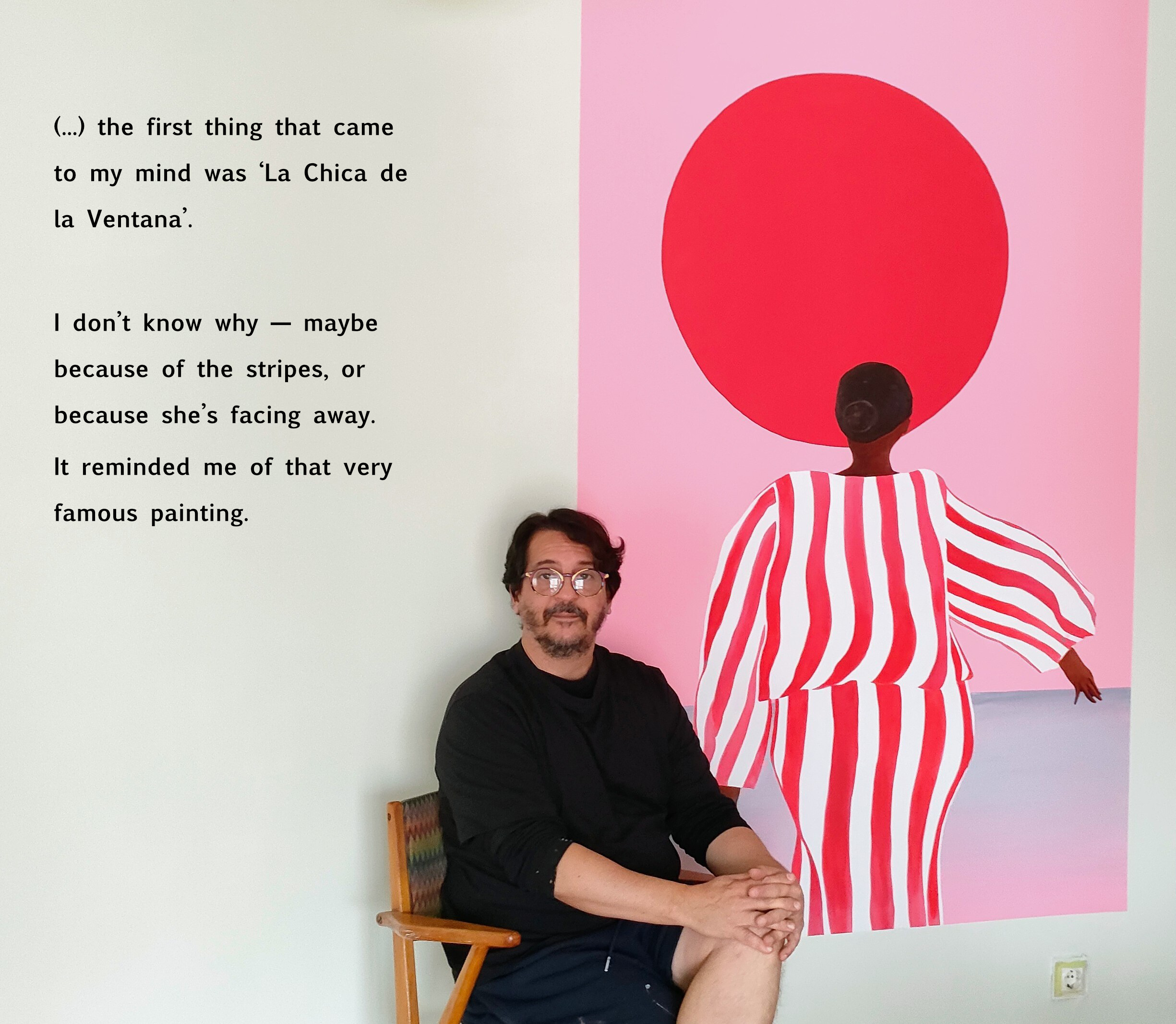
The Woman in the Painting
Me: (laughs) Okay, so in the end — the last question: who is this woman? What do you think?
Carlos: As I told you before, the first thing that came to my mind was La Chica de la Ventana. I don’t know why — maybe because of the stripes, or because she’s facing away. It reminded me of that very famous painting. Then I also thought about Miami’s 90s color palette. But today, after looking more carefully at the sun and the background, I started thinking… no, this isn’t a real landscape. This isn’t Earth. I’d say she’s on another planet — looking toward a red sun that isn’t even the real sun. That red sun could be symbolic — maybe it’s a portal or something abstract. If you take your time and let your mind wander, you can find a lot of interpretations. The most remarkable thing is her skin, right?
Me: Yeah — I think she’s Brazilian or African. Looking at her skin tone and her hair structure — which looks a little like dreadlocks or an afro — it’s definitely something in that direction. I can imagine she’s sexy, a bit mysterious, but I chose her because she gives me a sense of peace.
Carlos: It’s true — there’s a calmness there. But the image also has something sci-fi about it. It reminds me of Ray Bradbury’s stories — something from the ’80s or ’90s — a scene where someone crosses into another world through a portal.
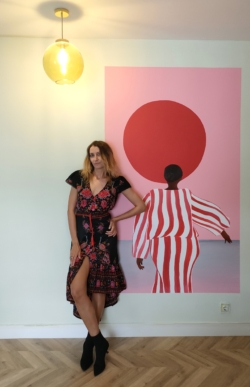 Me: (laughs) That’s so funny because we have two completely different visions. You go full science fiction, and I see it as total serenity. To me, she’s somewhere in the Caribbean, facing the sea. The wind is moving her hair and her dress. There’s this majestic sun that’s probably setting — that’s why there’s so much color. For me, she represents peace — like, deep inner calm. This painting feels so important to me personally. When I look at her, I instantly feel peace in my mind. It’s like I could meditate in front of that painting with my eyes open.
I always said that if I had a spare room, I’d fill it with art — a psychedelic room where I could just sit and meditate, absorbing the artwork. It’s not possible in my flat — there’s no extra space — but this painting gives me that feeling anyway. Eternal peace and calm.
Carlos: You know what’s interesting? Artists often debate who’s the observer — the one painting or the one looking at it. And what we’re doing right now is exactly that — our perspectives are merging. You talk about the scene — the physical place. I talk about the story behind it — the plot. It’s funny, but it works. It’s like one of those Ray Bradbury stories — a woman in a peaceful moment that suddenly becomes something cosmic.
Me: For me, it’s always about emotion — and that flowing dress is everything. It’s wavy, oversized, made of soft fabric. Kind of simple — maybe even one piece, or a combination of a blouse and skirt.
She’s just a beautiful woman and I’d love to know who she is — the real woman behind that photo. I honestly can’t express my gratitude enough. I knew I was giving you something nearly impossible to accomplish — it was a digital print, and we used regular paint, directly on the wall, not even on canvas. And somehow, we recreated it one to one. There’s barely any difference.
So, thank you so much for being part of this project. I really hope this is just the beginning of your amazing journey in home decor — and that your next project will be even more challenging.
Carlos: Thank you. Let’s see what the future brings us.
Get in touch with Carlos via his Instagram or website.
It’s really fulfilling to write this article now, sitting at my table and looking at this majestic painting. I once read that the entire point of life is to take chances on dreams that seem crazy to most, but feel like destiny to you. It resonates with me deeply.
When I first saw the flat after the renovation, I knew I needed something crazy, bold, mind-blowing on one of my walls. Something beyond anything I’d seen or done so far. And there she is, bringing both edge and peace at the same time.
I could’ve given up on it a thousand times, but I didn’t — and I’m grateful I stayed resilient.
In the next article, I’ll tell you about my furniture-hunting adventures in Madrid, and a few bruises I got along the way.
What’s the craziest idea you’ve pulled off in your own apartment?


Loved reading this behind-the-scenes story! The mix of chaos and creativity from Pinterest scrolling to paint mixing made it feel like a real, human art project rather than a polished home decor tutorial.
Thank you for your comment! It was indeed a very big home project, but results is just great!